HISTORY OF THE CULTURE
The Golden Era of Hip Hop
From its 1970s Bronx roots to its worldwide influence. Here, “golden era” celebrates hip hop’s early years and lasting influence; in music history, the term often refers more specifically to the late 1980s and early 1990s.
When it was new and fresh
Imagine hearing a DJ stretch the break, an MC turn everyday words into a rhythm, or a record scratched into a new sound for the first time. Then picture a dancer freezing on the beat and a subway car covered in huge, colorful letters. For people discovering it, this felt fresh—something they had never seen or heard before.
Hip hop drew on older music, dance, and art traditions, but the way young people brought them together was creating a new culture. The sound had a look. The look had an attitude. You could hear it, see it, wear it, and become part of it.
It started with a party
On August 11, 1973, in the rec room of 1520 Sedgwick Avenue in the West Bronx, Cindy Campbell organized a back-to-school party with her brother, a young Jamaican-born DJ named Clive Campbell. He went by DJ Kool Herc. That gathering is widely commemorated as hip hop’s birthday.
Herc noticed the crowd went wildest during the “break,” the drum-heavy part of a record. With two turntables, he moved from break to break, keeping the dancers going. His “Merry-Go-Round” approach helped lay the groundwork for hip-hop DJing; other pioneers developed their own precise ways to extend and manipulate those breaks.
The dancers who exploded onto the floor during those breaks became known as break boys and break girls, or b-boys and b-girls. A culture was taking shape in the Bronx.
Out of the fire
The Bronx in the 1970s was a place much of the country had written off. The Cross Bronx Expressway had divided neighborhoods and displaced families. Disinvestment, building abandonment, fires, job losses and cuts to city services left deep scars. The 1977 blackout added to the images of crisis on the evening news.
Young people facing limited resources and places to gather built their own spaces for creativity. They had turntables wired to streetlights, cardboard laid down on the sidewalk, spray paint, and their voices. Drawing on Black American music, Caribbean traditions and the creativity of their neighborhoods, they made something new. Teenagers who refused to disappear helped build a culture that the world would come to know.
The five elements
Hip hop is commonly described through four core elements. Many practitioners also recognize knowledge as a fifth: knowing the culture, its history and yourself.
- 01 / DJing
- DJ Kool Herc helped lay the foundation. Grandmaster Flash developed precise techniques for cutting between records, and Grand Wizzard Theodore is widely credited with pioneering the scratch.Names to know: DJ Kool Herc · Grandmaster Flash · Grand Wizzard Theodore.
- 02 / MCing
- It started with hyping up the crowd and grew into rhyming, storytelling and rap. Early MCs helped turn the microphone into an instrument for personality, rhythm, and stories from the streets.Names to know: Coke La Rock · Melle Mel · Kurtis Blow.
- 03 / B-boying & B-girling
- This was the dance, the heartbeat of the party. Toprock, footwork, power moves, and freezes gave dancers their own language, with crews helping develop and share the style.Names to know: Crazy Legs · Frosty Freeze · Ken Swift — members of the Rock Steady Crew.
- 04 / Graffiti
- Writers turned subway trains into rolling art galleries, carrying their names through every borough. Distinctive letters, characters, and color made a writer’s name recognizable across the city.Names to know: Lee Quiñones · Lady Pink · Futura 2000.
- 05 / Knowledge
- Understanding your roots and respecting the culture. Afrika Bambaataa and the Universal Zulu Nation helped promote hip hop as a connected culture. KRS-One and the Temple of Hip Hop have emphasized learning, teaching, and preserving its history.Names to know: KRS-One · Afrika Bambaataa. Organizations: Universal Zulu Nation · Temple of Hip Hop.
B-boying: the battle and the art
Breaking offered a way to compete through creativity. Crews faced off in circles called cyphers, and respect was earned by being more creative, more original and more fearless than the other side.
- Toprock
- The standing steps that opened your set, where you showed your attitude.
- Downrock and footwork
- Dropping to the floor and moving your legs through fast, tight patterns.
- Power moves
- Windmills, headspins, backspins and flares, the moves that made crowds lose their minds.
- Freezes
- Locking into a pose on the beat, like a mic drop with your whole body.
In 1977, the Rock Steady Crew formed in the Bronx. With members including Crazy Legs and Frosty Freeze, they helped take breaking from New York’s neighborhoods to movie screens and stages around the world. Black and Puerto Rican dancers were central to the dance’s development, and their style, flavor and pride remain part of it.
Graffiti gave the culture a face
A name became a piece of art. Writers stretched letters, locked them together, and built them up with outlines, arrows, highlights, crowns, and drips. Subway trains carried those names through the city, while walls and sketchbooks became places to develop a style people could recognize.
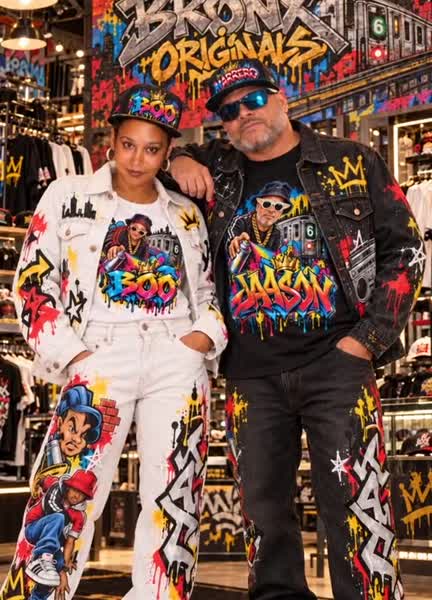
That same urge to stand out moved onto clothing: painted jackets, customized denim, personal lettering, and designs that represented a name or a neighborhood. Graffiti connected the art on the street with the way people dressed.
The clothes were part of the culture
The outfit mattered from head to toe. Lee jeans, Kangol hats, sheepskins, big glasses, windbreakers, and matching Adidas suits helped create a look you could recognize before the music even started.
- Lee jeans & denim
- Pressed creases, clean denim, and jackets made personal with artwork, patches, or lettering.
- Kangol hats & CAZAL glasses
- Bucket hats and caps, paired with bold, oversized CAZAL glasses.
- Sheepskins & windbreakers
- Sheepskin coats, shearling jackets, and light windbreakers brought warmth, color, and attitude.
- Adidas suits
- Matching track jackets and pants put sportswear into the everyday language of street style.
- Shell-toes & fat laces
- Adidas Superstar shell-toes and Puma sneakers, with wide, flat laces chosen to finish the outfit.
- Name belts & gold chains
- Personalized name belts, nameplate buckles, and rope chains made your name part of what you wore.
Fresh meant paying attention to the details: the crease, the laces, the hat, the colors, and how you put it all together. People took familiar clothes and gave them their own identity.
From the block to the big screen
As audiences discovered hip hop, these films helped carry its music, movement, and style beyond New York.
Flashdance
Rock Steady Crew’s breaking appearance put the dance in front of a mainstream movie audience.
Wild Style
Graffiti writers, MCs, DJs, and breakers shared the screen, with performers and artists from the scene bringing its energy to the film.
Beat Street
Young Bronx characters pursued DJing, rapping, graffiti, and breaking, giving audiences a view of the culture’s connected art forms.
Krush Groove
Run-D.M.C., Kurtis Blow, the Fat Boys, and other performers brought rap’s stage presence and record-business ambitions to the screen.
The culture was already alive in the neighborhoods. The movies helped more people see it, hear it, and want to be part of it.
The lifestyle
The music, graffiti, dancing, and clothing belonged together. A boombox, a fresh outfit, a name belt, and a style of lettering could all say something about who you were. It was a lifestyle, carried into everyday life.
The era was about crew, block and borough. Your crew was your family. Your block was your stage, and the whole Bronx was your proving ground. You represented where you came from: your projects, your avenue, your train line. You battled to win, but you respected anyone who brought something real.
Why the era still matters
- It was original. Young people built on musical, dance and art traditions to invent new moves, beats and letter styles.
- It was ours. Kids from the Bronx created it for themselves.
- It turned pain into power. In some of the hardest years the borough ever saw, young people answered with art, dance and music.
- It brought people together. Black, Puerto Rican, Jamaican and other kids on the block shared the same cypher.
- It reached the world. From “Rapper’s Delight” in 1979 to the films Wild Style (1983) and Beat Street (1984), the culture reached new audiences. In 2024, breaking made its Olympic debut in Paris. That worldwide journey carries the legacy of the Bronx and places like the rec room on Sedgwick Avenue.
Explore the history and its pioneers
Continue exploring the culture through these museum, archive and historical resources.
- 1520 Community Center — the August 11, 1973 party
- Rock & Roll Hall of Fame — DJ Kool Herc
- DJ Kool Herc’s firsthand account — the party and the Merry-Go-Round
- Smithsonian — the four elements of hip hop
- Library of Congress, Citizen DJ — knowledge and the golden age
- Smithsonian — Grand Wizzard Theodore and the scratch
- Coke La Rock’s firsthand account — early MCing with DJ Kool Herc
- Rock & Roll Hall of Fame — Grandmaster Flash, Melle Mel, and the Furious Five
- Kurtis Blow — official biography
- Ken Swift — breaking and the Rock Steady Crew
- Museum of the City of New York — Lee Quiñones, Lady Pink, and Futura 2000
- Temple of Hip Hop — teaching and preserving the culture
- Crazy Legs’s firsthand account — the Rock Steady Crew
- The Museum at FIT — Fifty Years of Hip Hop Style
- Lee — denim’s place in hip-hop style
- CAZAL — eyewear and 1980s hip-hop culture
- Encyclopedia of Clothing and Fashion — hip-hop clothing and accessories
- The Criterion Collection — hip-hop’s big-screen breakthrough
- Museum of the City of New York — Rock Steady Crew in Flashdance
- Wexner Center for the Arts — Krush Groove (1985)
- Library of Congress — “Rapper’s Delight” (1979)
- MoMA — Wild Style (1983)
- BFI — Beat Street (1984)
- World DanceSport Federation — breaking at Paris 2024